Welcome to Yongyi Fasteners, Your Reliable Fastener Supply Partner!

-
ProductsWe supply flat washers, spring washers, drop-in anchors, anchor bolts, hex nuts, hex bolts, sleeve anchors, threaded rods and OEM fastener products to DIN, BS, ANSI and MS standards.

-
About usHEBEI YONGYI FASTENERS MANUFACTURING CO.,LTD is located in China's largest fasteners production base Yongnian fasteners centre.
-
NewsHebei Yongyi Fasteners shares company updates, product knowledge and fastener industry news for global buyers.
-
ServiceThe products sold throughout the domestic and exported to Southeast Asia and Europe and other countries and regions. Our products win good reputation with domestic and foreign customers.



Support stable quality from material selection, processing and inspection to final delivery.
FOCUS ON HOT SPOTS
09
2021-07
China tightens crackdown on capital market violations
EIJING -- China has tightened crackdown on illegal activities in the securities market to promote the high-quality development of the country's capital market. Efforts to improve the securities legislation mechanism will be enhanced, and criminal punishment and market discipline will be strengthened, according to an official document jointly issued by the General Office of the Communist Party of China Central Committee and the General Office of the State Council. The document specifies targets for upgrades of the securities law enforcement and judicial systems by 2022 and 2025, respectively. The targets include curbing the frequent occurrence of major illegal and criminal cases, and making notable advances in the transparency, standardization and credibility of the securities law enforcement and judicial systems. Tang Xin, a professor with the School of Law at Tsinghua University, said the document will be a key factor in capital market legalization as it has set specific schedules for the formulation and revision of laws and regulations, and has provided supplementary measures to guarantee the implementation of the laws and policies. Due to system design shortcomings and the subsequent low cost of committing a crime, it was not unusual that some listed firms have taken advantage of the loopholes to engage in illegal acts such as financial fraud, insider trading and market manipulation. Thus the document calls for improved investigation, inspection and trial mechanisms. The country should strengthen its cross-border oversight of law enforcement and judicial cooperation, and step up efforts to build up the credit system in the capital market, according to the document. Setting out powerful and targeted measures, the document aims to purify China's capital market and bolster investor confidence, said Han Qian, a professor with the School of Economics at Xiamen University. In an exclusive interview with Xinhua, Yi Huiman, chairman of the China Securities Regulatory Commission, said the document would provide an essential guarantee for comprehensively deepening capital market reform and promoting its high-quality development. The country will strictly and promptly investigate and deal with major criminal cases such as fraudulent issuance, market manipulation, insider trading, and fabricating and disseminating false information, he said. Over the next three to five years, China's securities regulators will strive to fully implement the tasks set out in the document and provide a solid legal guarantee for the development of the capital market, he added.
2021-07-09
05
2021-07
Experts: China to remain haven for foreign investors
China's steady economic recovery from the impact of COVID-19 has effectively stabilized global investment and cushioned Asia from the hit of the pandemic, experts said. However, going forward more efforts will be needed to energize domestic manufacturing investment and consumption and stabilize trade. A report released in June by the United Nations Conference on Trade and Development showed that global flows of foreign direct investment had suffered a heavy blow from the pandemic. Global FDI flows fell by 35 percent in 2020, to $1 trillion from $1.5 trillion the previous year, the report said. In particular, FDI to developed economies slumped by 58 percent year-on-year, mainly due to pandemic-induced investment obstructions. Lockdowns slowed down existing investment projects, while the prospect of a recession led multinational enterprises to reassess new projects, the report said. According to the UN trade and development body, Asia was the only region that registered positive FDI growth, with China the largest overseas investor and the second-largest recipient of global investment in 2020. "China's quick recovery from the pandemic has made the country a popular destination for overseas capital, while the government's arduous efforts last year in removing foreign investment barriers, enabling an investment climate and expanding market access for foreign investors, have added to China's attractiveness for investors worldwide," said Bai Ming, deputy director of the Ministry of Commerce's International Market Research Institute. In the long term, a global decline in FDI will hamper optimal allocation of resources and production factors, he added. The signing of the Regional Comprehensive Economic Partnership agreement has cemented the region's stability and attractiveness as a well-connected, important global supply chain, Bai said. The UN trade report indicated that capital flow into Asia remained steady. FDI flows to countries in Asia increased by 4 percent in 2020, reflecting the region's resilience amid the global contraction in FDI. "Despite the pandemic, FDI to and from the region remained resilient in 2020. A developing Asia is the only region recording FDI growth, accounting for more than half of global inward and outward FDI flows," James Zhan, UNCTAD's director of investment and enterprise, said in a statement. The prospects for FDI in Asia this year are more favorable than the global average, due to the recovery in trade, manufacturing activity and a strong GDP growth forecast, Zhan said. Tu Xinquan, dean of the China Institute for WTO Studies at the University of International Business and Economics, said China's effective pandemic control made its comparative advantage in the manufacturing sector more prominent last year. He said with developed economies likely to rev up in the second half of the year, demand will climb and China's foreign trade will keep growing. Its attractiveness as a destination for overseas capital will continue, Tu added. Domestically, policy measures are needed to energize domestic manufacturing and boost consumption to make growth more stable and balanced, some economists believe. Zhong Zhengsheng, chief economist with Pingan Securities, said in a statement on Saturday that in the first six months of this year, economic recovery was mainly driven by services and investment in real estate, infrastructure and manufacturing. Consumption was one of the relative "weak links" in the recovery. He said that total social financing as well as M2, a broad measure of money supply that covers cash in circulation and all deposits, are likely to grow steadily.
2021-07-05
03
2021-07
Bonds with people key to CPC success
On the 100th anniversary of the founding of the Communist Party of China, overseas experts say the Party's popularity will continue to grow across the country as it is deeply rooted in the people and serves the needs of the people. Speaking at a grand gathering to mark the centenary of the CPC in Beijing on Thursday, Xi Jinping, general secretary of the CPC Central Committee, said: "This country is its people; the people are the country. As we have fought to establish and consolidate our leadership over the country, we have in fact been fighting to earn and keep the people's support." He added: "The Party has in the people its roots, its lifeblood, and its source of strength. The Party has always represented the fundamental interests of all Chinese people; it stands with them through thick and thin and shares a common fate with them." The success of the CPC lies in the simple fact that "it has heard the people and delivers the people's realistic needs", said Stephen Perry, chairman of The 48 Group Club, an independent business network group committed to promoting trade and cultural links between the United Kingdom and China. "China has transitioned from the 'sick man of Asia' to a leading global nation in those 100 years. This is due to the hard work and sacrifice of the people of China and the CPC leadership based on hearing the people and developing realistic steps to rebuild China," he told China Daily. "Without the people, this could not be achieved, and without the CPC this could not be achieved," he added. "The CPC has used hard work and commitment to find the right paths and been brave in innovation." Since it was established in July 1921, the CPC has led China to transform from a large but poor and weak nation to the world's second-largest economy, lifting about 770 million of its people out of poverty. "This is unprecedented in human history and unprecedented in world history," Perry said, adding: "China's management of the planned economy is unique and marrying it with the market economy is a great innovation which many nations will benefit from over time." "The CPC has 95 million members and it is a base for selfless commitment to helping China find its rejuvenation targets and help other nations who seek help," he said. A study published by Harvard University last July showed that the CPC-led Chinese government enjoys a high rate of support and satisfaction among the Chinese people, at a rate of more than 93 percent. "With achievements like that, it would be most surprising if it did not, because to transform the living conditions, the quality, and the expectations of society and the Chinese people, has created entirely new possibilities for its population," said Martin Jacques, a leading British Sinologist. "If a party or a government is capable of doing it, it's going to be enormously popular. There is nowhere else in the world probably that could achieve these kind of levels of satisfaction, so I do not think we should be surprised by it," he said during an interview with China Daily. George Koo, a retired international business adviser in Silicon Valley, the United States, and a political commentator, agreed. "The most obvious success of the CPC is the fact that they have taken care of all the people in China. By taking care of all the people, they have popular support, the overwhelming percentage of support, like no other government or party has been able to enjoy anywhere in the world." Kin Phea, director-general of the International Relations Institute of Cambodia at the Royal Academy of Cambodia, said unity between the Party and the people is crucial for China's development. "Over the last century, the CPC has remained true to its original aspiration and mission of pursuing the well-being of the Chinese people, leading them in an arduous and never-ending struggle that has resulted in fundamental changes not only in the destiny and future of the Chinese people and nation, but also in the destiny and future of the peoples and nations in the region and the world." In his speech on Thursday, Xi also said that "a hallmark that distinguishes the Communist Party of China from other political parties is its courage in undertaking self-reform". Jacques agreed that the ability to reform is another reason that the CPC has achieved so much. "The CPC has this extraordinary reforming capacity," he said. "One of the things that the CPC has been remarkably good at is moving with the times. It understands the dynamics of the society and moving with it, and therefore being able to change the direction whenever it needs to change." As an example of the reform-oriented mindset, Jacques noted how late leader Deng Xiaoping had realized that the centralized economic governance system was hindering China's economy before the 1980s. Deng led the nation to embrace the market as integral to China's socialist system, and ultimately, the nation was integrated into the global economy. "That was a
2021-07-03
01
2021-07
Top leader addresses CPC centenary gathering
Xi Jinping, general secretary of the Communist Party of China Central Committee, delivered an important speech at a grand gathering celebrating the centenary of the CPC's founding at Tian'anmen Square in Beijing on Thursday. Here are the highlights: - China has realized the first centenary goal -- building a moderately prosperous society in all respects. This means that we have brought about a historic resolution to the problem of absolute poverty in China, and we are now marching in confident strides toward the second centenary goal of building China into a great modern socialist country in all respects. - The CPC has united and led the Chinese people over the past 100 years for one ultimate theme -- bringing about the great rejuvenation of the Chinese nation. - Seeking happiness for people and national rejuvenation has been Party's aspiration and mission since founding. - The Party unites and leads the Chinese people in fighting bloody battles with unyielding determination, achieving great success in the new-democratic revolution. - The Party unites and leads the Chinese people in endeavoring to build a stronger China with a spirit of self-reliance, achieving great success in socialist revolution and construction. - The Party unites and leads the Chinese people in freeing the mind and forging ahead, achieving great success in reform, opening up, and socialist modernization. - The Party unites and leads the Chinese people in pursuing a great struggle, a great project, a great cause, and a great dream through a spirit of self-confidence, self-reliance, and innovation, achieving great success for socialism with Chinese characteristics in the new era. - The time in which the Chinese nation could be bullied and abused by others was gone forever. - Only socialism could save China, and only socialism with Chinese characteristics could develop China. - The CPC and the Chinese people, through tenacious struggle, have shown the world that China's national rejuvenation has become a historical inevitability.
2021-07-01
29
2021-06
China, Russia pledge to enhance ties
Xi, Putin announce extension of key China-Russia treaty during video talks Beijing and Moscow agreed on Monday to extend the China-Russia Treaty of Good-Neighborliness and Friendly Cooperation to boost the high-level development of bilateral ties, and they also pledged to jointly uphold real multilateralism and safeguard global strategic security and stability. President Xi Jinping and his Russian counterpart Vladimir Putin announced the extension of the treaty, which was signed by the two countries 20 years ago, in a joint statement in their talks via video link. The treaty has laid a solid legal foundation for the long-term and healthy development of China-Russia relations. During the online talks, Xi said the concept of the friendship for generations established by the treaty conforms to the fundamental interests of the two countries as well as the theme of the times to promote peace and development. It is also a vivid practice of building the new type of international relations and a community with a shared future for mankind, Xi added. Today's China-Russia ties are "mature, stable and solid" and can withstand the test of changes in the international landscape, he said, adding that the two countries support each other on issues related to their respective core interests with effective strategic coordination, and have safeguarded their shared interests. They have also developed fruitful pragmatic cooperation as well as close coordination on international affairs, jointly safeguarding real multilateralism and international fairness and justice, Xi said. As the world enters a period of turbulent change and human development encounters multiple crises, Xi said close cooperation between China and Russia has provided positive energy to the international community, and has set an example for a new type of international relations. China is confident that guided by the spirit of the treaty, the two neighboring countries will remain focused on developing bilateral ties regardless of possible challenges, he said, adding that the country firmly supports Russia in taking strong measures to safeguard its long-lasting peace and security. Putin extended congratulations to Xi, who is also general secretary of the Communist Party of China Central Committee, on the 100th anniversary of the CPC's founding on July 1, and expressed his hope that China, under the leadership of the CPC, could make new achievements in socioeconomic development and play a more important role in international affairs. The Russian president said his country is satisfied with the unprecedented high-level development of bilateral relations as well as the nations' all-around, steady bilateral cooperation. The extension of the treaty will lay an even stronger foundation for the long-term development of Russia-China relations, he added. Moscow stands ready to work with Beijing to strengthen strategic mutual trust, develop even closer strategic coordination, continue to support each other's efforts to safeguard their respective national sovereignty and territorial integrity and respect each other's system and development path of their own choice, Putin said. Both countries emphasized the need to jointly uphold the international system with the United Nations at the core as well as the international order underpinned by international law, according to a news release issued after the talks. They also pledged to oppose external interference in domestic affairs under the guise of "democracy" and "human rights", as well as unilateral sanctions. The two countries agreed to jointly promote peace, development, fairness, justice, democracy and freedom, intensify solidarity and coordination to cope with common challenges, and advance the building of a community with a shared future for mankind. They stressed jointly opposing stigmatizing and politicizing the COVID-19 pandemic and virus origin tracing, and pledged to strengthen vaccine cooperation, maintain close high-level exchanges, expand bilateral trade and advance the synergy of the Belt and Road Initiative with the Eurasian Economic Union. The two countries also vowed to work together to oppose politicizing sports, and Moscow supports Beijing in hosting successful Winter Olympic Games in 2022. While underlining the need to comprehensively plan and promote the development of the Shanghai Cooperation Organization, they also expressed concerns over the security situation in Afghanistan caused by the United States' speedy withdrawal of its troops from the country, and stressed the need to jointly uphold regional peace, security and stability.
2021-06-29
28
2021-06
Key Shenzhen foreign trade port resumes operations
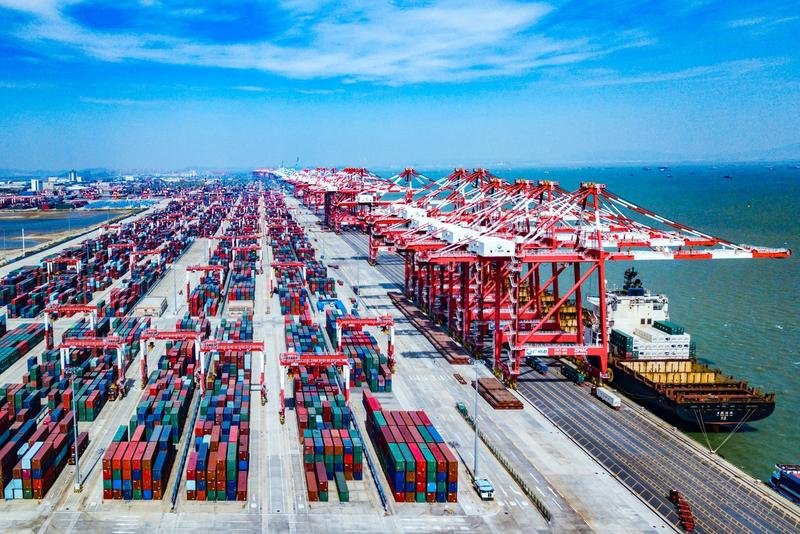
The resumption of normal operations at Yantian Port in Shenzhen, southern China's Guangdong province, will help stabilize electronics prices and address supply shortages of commercial goods in many parts of the world, government officials and experts said on Thursday. They made the remarks after the world's fourth-busiest container port resumed operations on Thursday, following a monthlong cut in productivity caused by a COVID-19 outbreak. Coronavirus cases among dockworkers at Yantian Port have caused serious disruptions to the port since late May. Shipping companies, including Maersk, COSCO Shipping Lines and CMA CGM Group, have all warned customers that it would take several weeks to clear up the immense container backlog in the region that has put strains on global supply chains over the past four weeks. The impact of this congestion on China's overall foreign trade is limited and controllable, said Gao Feng, a Ministry of Commerce spokesman, adding that the Guangdong provincial government has already taken effective measures to reduce shipping backlogs at its ports. "For the next step, we will continue to strengthen the collaboration between central government branches and local governments to create better conditions for foreign trade and international logistics services," he said. Yantian Port resuming normal operations will help restore the global supply of electronic consumer goods, electrical machinery, household appliances, medical equipment, auto parts and furniture, much of which is manufactured in China's Pearl River Delta region, said Zhao Ying, a researcher at the Chinese Academy of Social Sciences' Institute of Industrial Economics in Beijing. As one of China's major container shipping ports, Yantian Port serves more than one-third of Guangdong's foreign trade and one-fourth of the country's trade with the United States, according to the district government of Yantian, Shenzhen. "Currently, there are 23 ships conducting loading operations at the port," said Lawrence Shum, managing director of Hutchison Ports Yantian, the operator of Yantian Port. The number of workers at the port has soared from 360, after the outbreak occurred in late May, to the current 4,462, and all of the berths at its central and western areas where confirmed COVID-19 cases were discovered have resumed operations, with their total throughput reaching 33,000 twenty-foot equivalent units. "Many shipping companies are confident in our efforts to resume operations in a steady manner and have planned and prepared to berth their ships at the port again," Shum added. Yuan Huyong, deputy head of the Yantian Port command center for COVID-19 control and prevention, said the government will continue to impose strict COVID-19 prevention and control measures on high-risk personnel working at the port to ensure its safe and efficient operation. The terminal of Yantian Port serves 100 vessels per week. Its container throughput reached 13.35 million containers in 2020, up 2.13 percent year-on-year, accounting for 50.28 percent of the container throughput of Shenzhen's port areas, according to the Yantian Maritime Safety Administration. "With the easing of the pandemic in Europe and the US and the continuous introduction of consumption stimulus plans, global demand has picked up, and the demand for shipping logistics has gradually increased. However, the recovery cycle of shipping capacity has not been realized as quickly," said Wang Guowen, director of the Center for Logistics and Supply Chain Management at the China Development Institute, a think tank based in Shenzhen. "Due to Asia-wide COVID-19 flareups, we have seen a return of manufacturing to China for products normally produced elsewhere to take advantage of China's relatively stable manufacturing base," said Ditlev Blicher, managing director of Maersk Asia Pacific, a part of A.P. Moller-Maersk, the Danish shipping and logistics giant.
2021-06-28
Welcome To Know Our Products
Get Product and Service Information
Follow us
We provide OEM service and focus on stable quality, competitive pricing and responsive export support.


Contact Info
Add:Dongmingyang Industrial Park, Mingguan Town, Yongnian District, Handan City, Hebei Province China
Export salesman:
WhatsApp:+86 18830064300
E-mail: sales@hgtfix.com
Export salesman:
WhatsApp
+86 18830064300
E-mail:
Copyright © 2022 HEBEI YONGYI FASTENERS MANUFACTURING CO.,LTD Power by 300.cn | SEO